

Many enterprises encounter the same problem when using wire-wound filter element: the filter element has an extremely short service life. It gets clogged, the pressure difference rises, and the output water volume decreases within just a few days or even hours, requiring frequent shutdown for replacement. This not only increases the cost of consumables but also seriously affects the continuous operation of the production line. In fact, the rapid clogging of most Polypropylene string wound filter element is not a quality issue, but rather it is caused by improper selection, installation, pre-treatment, and operation and maintenance methods. This article summarizes the efficient solutions commonly used in industrial sites to completely improve the problem of frequent yarn depth filter element clogging.
Firstly, the most crucial reason is the lack of pre-treatment, with excessive impurity load. wire-wound filter element are often the first line of filtration barriers. If the raw water or raw liquid contains a lot of sand, suspended solids, and high colloid content, all the impurities will accumulate on the surface of the yarn filter element, causing clogging within a short period of time. The solution is quite clear: install a coarse filtration device at the front end of the filter. You can add Y-type filters, bag filters, or sedimentation water tanks to intercept large particles of sand, rust, and flocculent substances, share the filtration pressure, and directly increase the service life of thepp string wound filter element by 2 to 3 times.
Secondly, choosing a filter element with too high a filtration accuracy is a common misunderstanding. Many users blindly select 1μm or 5μm high-precisionwire-wound filter element to pursue clean filtration. In the case of high impurity content, the higher the precision, the more likely it is to get clogged. The correct selection principle is stepwise filtration, from coarse to fine. The front stage should preferentially use 10μm, 20μm, or even 50μm filter elements to intercept most impurities, and then combine with high-precision Polypropylene string wound filter element at the back end for fine filtration to avoid overloading of the single-stage filter element and reduce the frequency of clogging from the root cause.
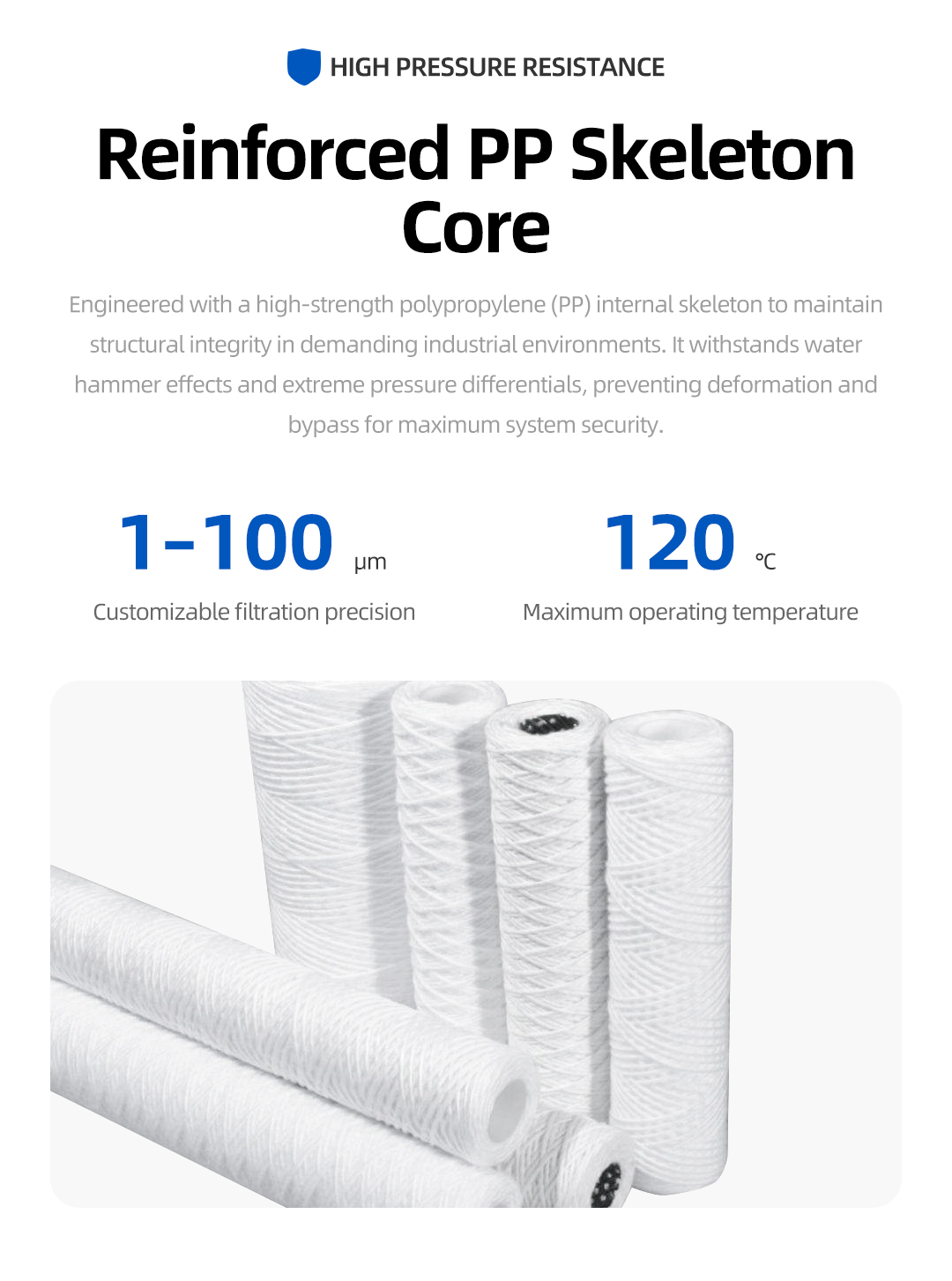
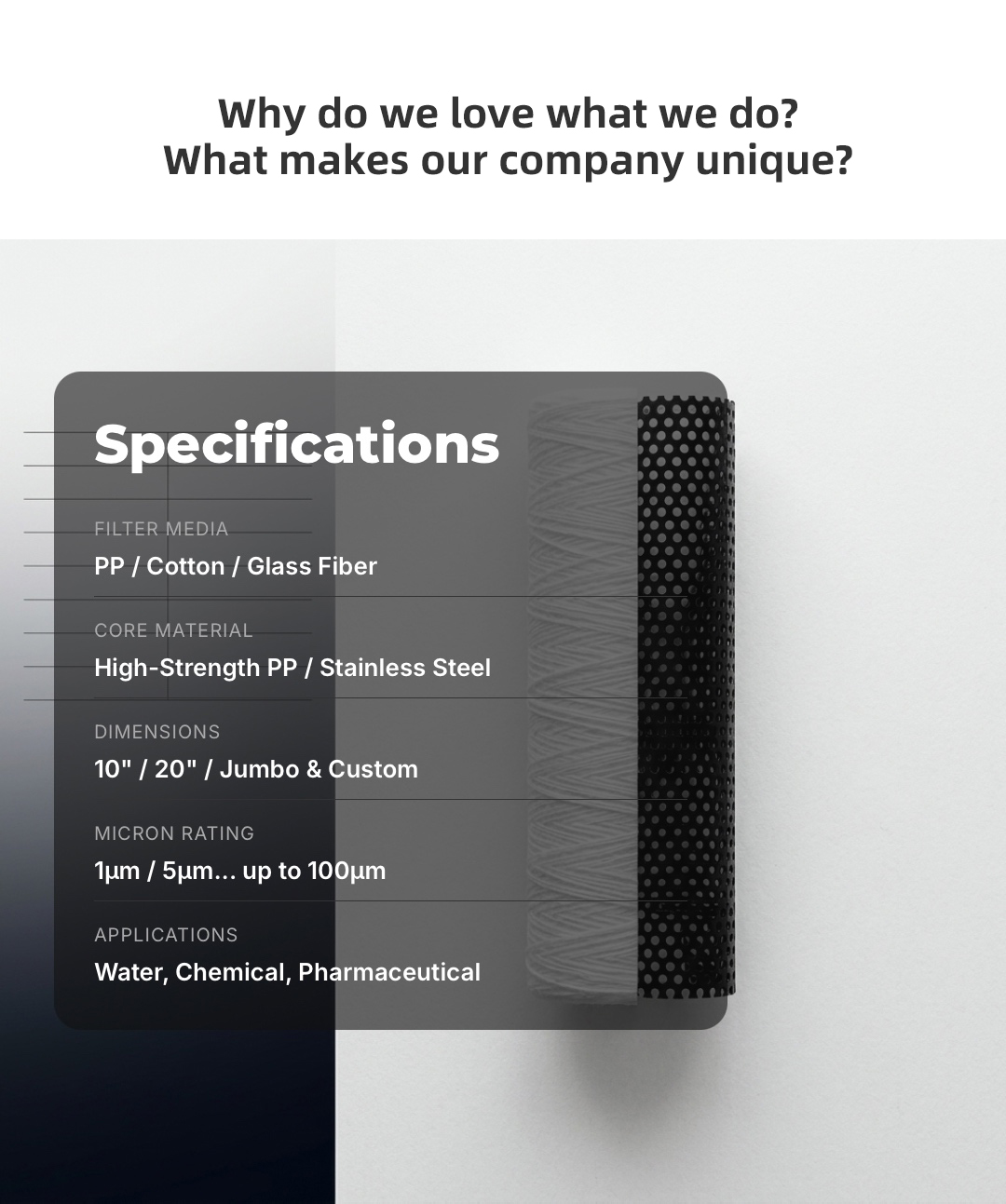
Furthermore, the mismatch between the material and the working conditions will accelerate the failure of the yarn depth filter element. Different fluids have greatly different losses on the filter element: high-viscosity paints, glues, oil stains, and hot liquids, using ordinary PPpp string wound filter element are very likely to stick holes, become compacted, and cannot be restored to the flow rate through rinsing. For high-viscosity and high-temperature conditions, it is recommended to replace with glass fiber or thickened and encrypted filter elements; for neutral fluids in food and electroplating, you can choose filter elements with stronger pollutant absorption capacity such as degreased cotton filter elements; for acid and alkali corrosive conditions, it is necessary to use corrosion-resistant PP materials to avoid fiber corrosion and detachment causing clogging of yarn filter element.
At the same time, improper installation and operation will also cause false clogging. If the sealing ring of the wire-wound filter element is misaligned or loose, impurities will accumulate in the interlayer; if the flow rate of the equipment is far beyond the rated flow rate of the filter element, it will cause instantaneous overload and clogging. During daily operation, you can regularly perform high-pressure flushing and forward-backward flushing on the washable Polypropylene string wound filter element to remove the accumulated impurities on the surface and restore the filtration flow rate. Additionally, for equipment that has been idle for a long time, the fluid sedimentation and deterioration will cause the yarn depth filter element to get clogged easily when restarting. It is recommended to drain the stagnant water in the pipeline before starting the equipment.
In summary, there is no need to frequently replace expensive consumables to solve the problem of rapid clogging of pp string wound filter element. By doing a good job in pre-coarse filtration, selecting a lower precision for the front stage, matching the corresponding material for the working conditions, and standardizing daily operation and maintenance, the service life of the yarn filter element can be significantly extended, the number of shutdowns for replacement can be reduced, and the overall operation cost of the factory's filtration system can be effectively lowered.