

In industrial water treatment, pure water production, and process fluid filtration systems, the pollution capacity is the core indicator for evaluating the comprehensive performance of filter elements, directly determining the replacement cycle of filter elements, the stability of system operation, and the overall operation and maintenance costs. Compared with traditional straight-through melt-blown filter elements, large flux filter element and large-flow filter elements have achieved a comprehensive performance breakthrough of high flow rate, high pollution capacity, and low pressure difference through unique structural optimization and filter material process upgrading. They have now become the mainstream selection for large-scale filtration systems. This article deeply analyzes the core design principle and engineering application advantages of high flux filter element with high pollution capacity.
I. Core design principle of high pollution capacity of large-flow filter elements
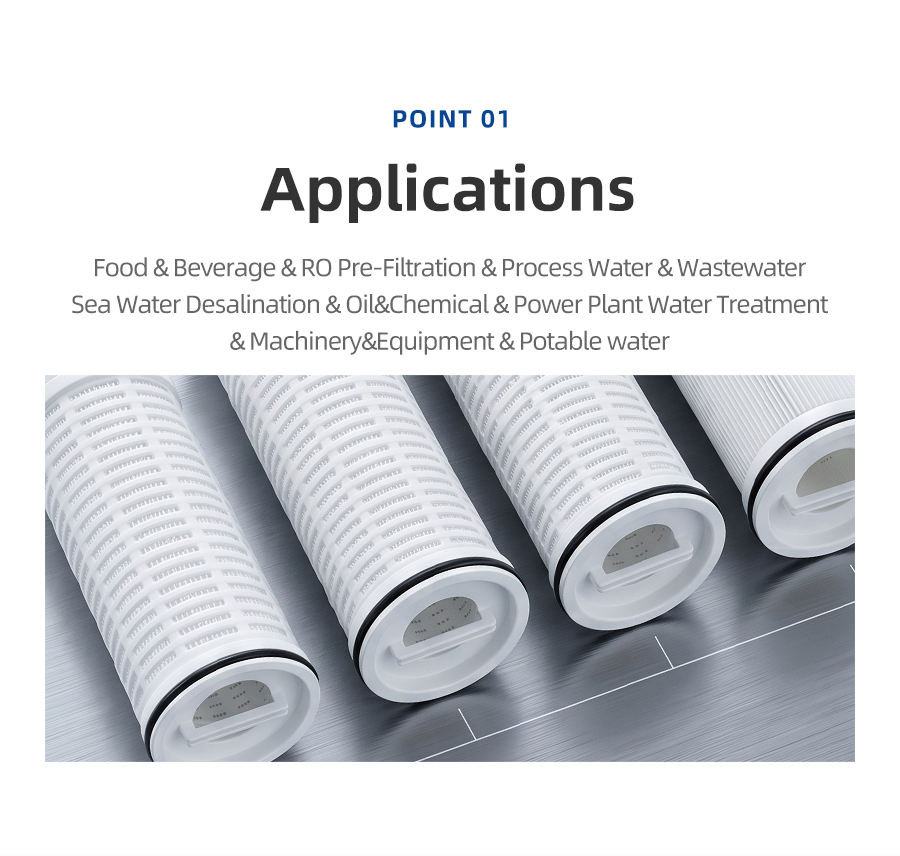
The pollution capacity of traditional filter elements is limited. The core weakness is the small effective filtration area and the single level of impurity retention. However, high flow pleated filter element, through structural and process optimization, have significantly increased the upper limit of impurity retention. Firstly, the folded structure design of the filter element evenly and precisely folds the flat filter material, maximizing the extension of the effective filtration area within the limited cylinder space. Compared with ordinary filter elements of the same size, the filtration area can be increased by 4-6 times, providing sufficient space for impurity retention.
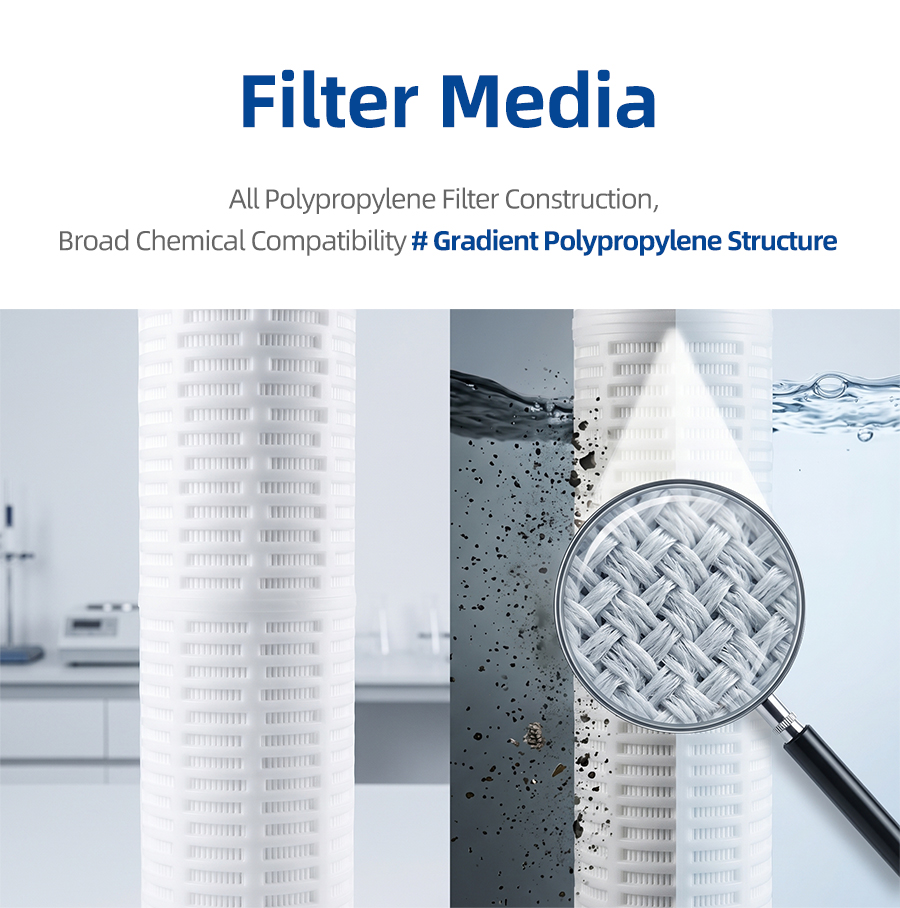
Secondly, the gradient filtration level process is adopted, with the filter material forming a gradually changing pore size structure from the outside to the inside. The outer layer with large pore diameters intercepts large particles such as suspended solids, sand, and rust first, while the inner layer with precise filter layers retains fine colloids and particles. The layered retention avoids rapid surface blockage of filter pores and realizes deep pollution retention, significantly increasing the overall pollution retention limit. At the same time, the integrated non-angled filter material encapsulation design eliminates side leakage of impurities and local accumulation of impurities, allowing the filter material to uniformly participate in filtration throughout the area, fully exerting the pollution retention performance of high flow water filter element.
II. Core performance advantages brought by high pollution capacity design
First, it extends the service life of consumables and reduces the replacement frequency. The high effective filtration area and gradient pollution retention structure significantly delay the speed of filter pore blockage. Under the same water quality and operating conditions, the service life of large flow filter element is 3-5 times that of ordinary filter elements, effectively reducing the number of consumables replacements and lowering the enterprise's procurement costs.
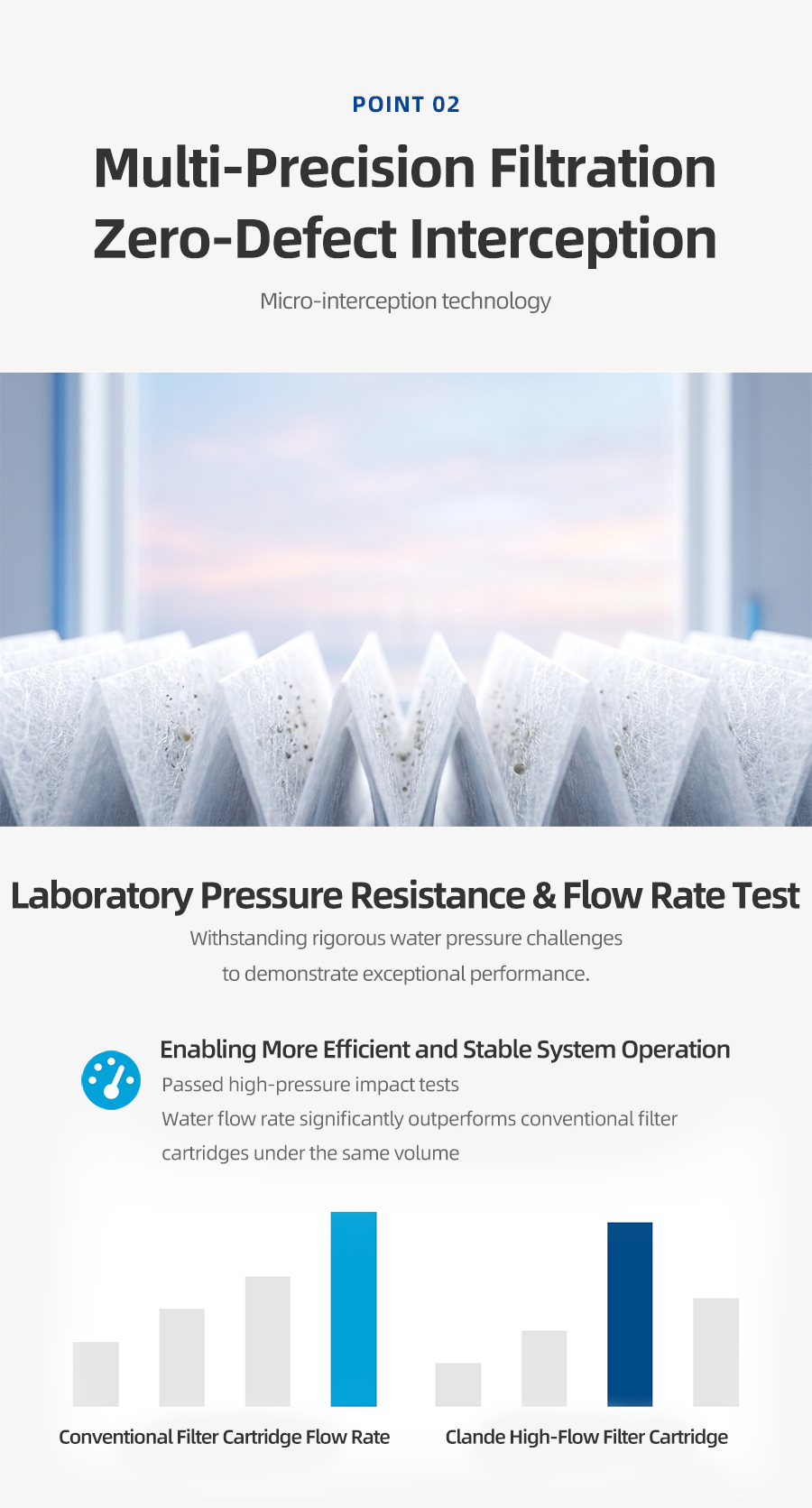
Second, it stabilizes the system pressure difference and ensures the continuous operation of equipment. Ordinary filter elements are prone to rapid surface blockage, resulting in a sudden increase in system pressure difference and a decline in flow rate, frequently triggering equipment shutdown for maintenance. High-pollution-capacity large flux filter element can maintain a stable pressure difference condition for a long time, with a slow decline in flow rate, and are suitable for industrial equipment to operate continuously for 24 hours, effectively improving production efficiency.
Third, it reduces manual operation and equipment wear. The longer replacement cycle significantly reduces the frequency of manual disassembly, maintenance, and equipment downtime. At the same time, the stable filtration state can fully protect core equipment such as reverse osmosis membranes, precision heat exchangers, and process pipelines, avoiding impurity wear and blockage of the rear-end components, and reducing equipment failure and maintenance costs ofhigh flow pleated filter element filtration systems.
III. Summary of engineering application value
The high pollution capacity characteristic of large-flow filter elements is essentially a solution to the industry pain points of "easily blocked, short lifespan, and large pressure difference fluctuations" of traditional filter elements. In high-precision and high-load filtration scenarios such as industrial pure water, chemical fluid, and circulating water treatment, high-pollution-capacity high flux filter element andhigh flow water filter element can not only ensure stable and compliant water quality output but also significantly reduce the overall operation and maintenance costs of the system. They are the core preferred components for industrial filtration systems to achieve energy conservation and efficiency improvement.